Baby leopard gecko care: the first 90 days
This post contains affiliate links. As an Amazon Associate, I earn from qualifying purchases at no extra cost to you.
Getting a baby leopard gecko is exciting. Keeping it alive and thriving through the first 90 days is where most first-time keepers stumble. Hatchlings under three months old are fragile in ways adults are not: fat reserves are minimal, immune systems are still maturing, and the stress of relocation alone can suppress feeding responses for weeks. The decisions you make in week one - about substrate, temperature, feeding frequency, and supplementation - will shape your gecko’s bone density, feeding behavior, and overall constitution for years.
Leopard geckos are forgiving if you get the fundamentals right. They don’t require complex lighting rigs, high humidity management, or live plants. What they need is stable heat, appropriately sized prey dusted correctly, clean hides, and a keeper who resists over-handling during the critical acclimation window. This guide covers specific setup requirements, feeding protocols, supplementation schedule, handling milestones, and warning signs to watch across the first 90 days of baby leopard gecko care. If you’re adding a hatchling to an existing collection, work through a proper quarantine setup first to protect your other animals.
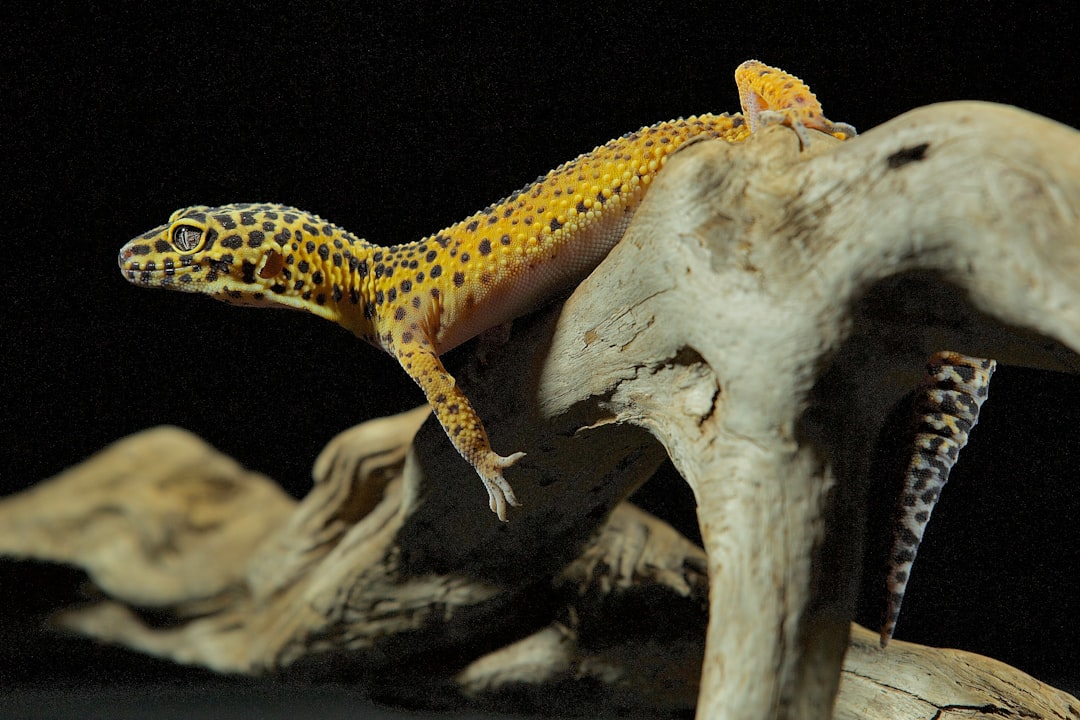
Photo by Andrey Tikhonovskiy on Unsplash
Setting Up Your Enclosure and Temperature Management
Baby Leopard Gecko Housing Setup
Baby leopard geckos don’t need a large enclosure - at least not initially. A 10-gallon tank or equivalent-footprint plastic tub is appropriate for the first several months. An enclosure that is too large makes it difficult for a hatchling to locate food, thermoregulate, and feel secure. For a prey animal, excess exposure is physiologically stressful and directly suppresses appetite and immune function.
The Exo Terra Faunarium Small PT2255 is a practical starting point for hatchlings. It offers adequate ventilation, a secure latch that prevents escapes, and a footprint that creates a genuine hot-to-cool gradient without excess open floor space. Translucent walls let you observe feeding behavior and hide use without opening the enclosure and disrupting the animal.
For substrate, paper towels are the correct choice during the first 90 days. They make it easy to monitor waste output, feeding success, and shed remnants - all metrics that matter significantly in the early weeks. Loose substrates including sand, coconut fiber, crushed walnut shell, and soil mixes carry ingestion risk for animals still developing hunting accuracy. Reserve naturalistic or bioactive setups for once your gecko is past three months old and eating reliably.
Furnish the enclosure with these four elements before your gecko arrives:
- A warm hide placed directly on or near the heat source on the hot side
- A cool hide at the opposite end of the enclosure
- A moist hide with damp sphagnum moss, positioned in the middle temperature zone
- A shallow water dish the gecko can access without risk of drowning
The moist hide is non-negotiable. Leopard geckos return to a humid microhabitat to complete a shed. Hatchlings shed every two to four weeks, and without consistent moisture access, retained shed around toes and eyelids is nearly inevitable. Reptifiles’ leopard gecko care guide recommends keeping the moist hide substrate damp but not waterlogged, replacing it every two to three days to prevent mold accumulation. Keep decor minimal during the first two weeks - two hides and a water dish is sufficient until the gecko is eating reliably and behaving normally.
Temperature and Heating
Temperature is the most critical environmental variable in baby leopard gecko care. Leopard geckos are ectotherms: every metabolic process - including digestion and immune response - depends entirely on the thermal environment you create. Low belly temperatures impair digestion directly; prey items can begin to decompose inside the gut before they are processed, causing regurgitation or systemic infection.
The gradient you need:
- Warm side floor temperature: 88-92°F (31-33°C), measured directly on the substrate surface above the heat source
- Ambient warm side air: 80-85°F (27-29°C)
- Cool side air: 72-78°F (22-26°C)
- Nighttime drop: allow the cool side to fall as low as 65-68°F (18-20°C)
Under-tank heaters (UTHs) placed beneath one-third of the enclosure floor provide the belly warmth leopard geckos use to digest prey. A UTH alone is insufficient if your room temperature drops significantly at night. Pair every UTH with a quality thermostat - running one without a controller is how you cook a gecko.
The Inkbird ITC-308 is a reliable dual-stage controller with separate heating and cooling setpoints. Connect your UTH to the heating outlet, set the probe at floor level on the warm side, and calibrate to your target surface temperature. The dual-stage design also provides an automatic safety shutoff if the enclosure overheats on warm days when room temperatures rise unexpectedly.
Verify all temperatures with a digital probe thermometer at floor level on the warm side. Infrared spot guns are useful for quick secondary checks but read surface emissivity inconsistently on different substrate materials. Adhesive strip thermometers measure air temperature at the glass surface and are notoriously inaccurate - they tell you almost nothing about what the gecko experiences at floor level.
On UVB: leopard geckos are crepuscular and don’t require UVB as urgently as strictly diurnal species, but VCA Animal Hospitals notes that supplemental UVB is increasingly recommended even for nocturnal and crepuscular reptiles. A low-output 2% UVB or T5 HO 5.0 lamp on a 10-12 hour photoperiod supports D3 synthesis and more naturalistic activity patterns. If you forgo UVB entirely, calcium supplementation with D3 at every feeding becomes essential - covered in the next section.
Feeding and Supplementation
Feeding Your Baby Leopard Gecko in the First 90 Days
Baby leopard geckos are strict insectivores. The first feeding decision is not about which insect to offer - it’s about timing. Most hatchlings need 48-72 hours of complete rest after arriving in a new enclosure before any feeding attempt. Trying to feed a freshly transported gecko almost always produces a refusal and adds unnecessary stress during an already vulnerable period.
Prey selection for hatchlings: Small crickets (1/4 inch) and small dubia roaches are the backbone of a practical hatchling diet. Both are gut-loadable, nutritionally adequate when properly prepared, and sized appropriately. Mealworms are high in fat and chitin relative to protein - use them occasionally rather than as a staple. Black soldier fly larvae (BSFL) have a superior calcium-to-phosphorus ratio and make an excellent rotation item. Waxworms function as treats only and should not be offered to animals under three months old.
Sizing prey correctly: Offer prey no wider than the distance between the gecko’s eyes. This is calibrated to the gecko’s actual swallowing capacity - oversized prey causes jaw strain, triggers regurgitation, and adds stress to a vulnerable animal.
Follow this feeding progression through the first 90 days:
- Days 1-3 (acclimation window): Offer no food. Provide fresh water in a shallow dish. Minimize enclosure disturbances entirely. The gecko has sufficient body reserves for this period, and forcing interaction only delays feeding acceptance.
- Days 4-30: Offer 5-8 appropriately sized crickets or dubia every other day in the evening. Remove uneaten prey within 20 minutes - live insects left overnight stress a resting gecko and have been documented to bite sleeping animals.
- Days 31-60: Increase to 7-10 prey items every other day. Begin tracking weight weekly with a gram scale. Healthy juveniles gain 1-3 grams per week. Two consecutive weeks of weight loss or plateau warrants a temperature check and closer observation of feeding behavior.
- Days 61-90: Maintain every-other-day feedings. Begin rotating between two prey species if you haven’t already. Dietary variety prevents prey fixation - a genuine management problem in adulthood when a gecko refuses new feeder types after prolonged single-item exposure.
At the 90-day mark, most keepers continue every-other-day feedings through the full juvenile growth phase. Young leopard geckos have high metabolic demands relative to body size and benefit from frequent, consistent prey offerings. For a detailed breakdown of feeder insects by nutritional profile and gut-loading protocols, the Leopard Gecko Diet guide covers each stage in full.
Calcium and Vitamin Supplementation for Baby Leopard Geckos
Supplementation is where many keepers either over-engineer the protocol or neglect it entirely. Both are mistakes with real consequences. Baby leopard geckos are growing rapidly, and bone and organ development during this window depends on adequate calcium and vitamin intake more than at any other life stage.
The supplementation schedule for hatchlings and juveniles:
- Calcium with D3 at every feeding: Dust prey with a phosphorous-free calcium powder that includes vitamin D3. The Rep-Cal SRP00200 Phosphorous-Free Calcium with Vitamin D3 is an ultrafine reptile/amphibian supplement powder. For geckos without consistent UVB exposure, this is the primary D3 source and should not be skipped.
- Multivitamin twice monthly: Rotate a reptile multivitamin onto prey items twice per month, using it in place of calcium on those two feeding nights rather than stacking it on top. Once monthly is too infrequent for a rapidly growing hatchling; more frequent than twice monthly creates risk.
- Plain calcium without D3 available passively: Keep a small bottle cap of plain calcium (no D3) inside the enclosure permanently. Some individuals will lick this directly, self-regulating intake. This is a safety net, not a substitute for active dusting.
If you are running UVB lighting consistently, reduce D3 dusting to every other feeding. Vitamin D3 is fat-soluble and accumulates rather than being excreted; chronic oversupplementation causes hypervitaminosis D - calcification of soft tissue including kidneys and major blood vessels. For geckos without any UVB access, every-feeding D3 calcium dusting for the first 90 days is the correct baseline. The same fat-soluble accumulation logic applies to multivitamins: daily use risks hypervitaminosis A, which presents in reptiles as periocular swelling, skin sloughing, and systemic organ dysfunction. Twice monthly is the established community standard for a reason.
Handling, Shedding, and Health Monitoring
Handling and Taming a Baby Leopard Gecko
The most counterintuitive aspect of baby leopard gecko care is the handling restriction. The acclimation window is not a suggestion. A hatchling handled repeatedly before it has settled into a predictable hide routine and begun eating reliably is a gecko under chronic stress - which suppresses appetite, degrades immune response, and increases susceptibility to opportunistic infections.
Once your gecko has accepted prey at three consecutive offered meals without refusal, begin handling sessions under these parameters:
- Keep initial sessions to 5 minutes maximum, once per day
- Handle close to the ground or over a table with a soft surface below
- Allow the gecko to walk from hand to hand rather than gripping or restraining it
- Return the gecko to its enclosure immediately if it shows stress signals: rapid tail wagging, vocalization, biting attempts, or continuous frantic movement that does not settle
Tail autotomy - the deliberate shedding of the tail as a defense mechanism - is less common in leopard geckos than in many other lizard species, but hatchlings under acute stress are at higher risk than adults. The regenerated structure is cartilage rather than bone, with a different texture, shape, and reduced fat storage capacity compared to the original. Protecting the original tail during the first 90 days is worth the patience investment.
By days 60-90, most baby leopard geckos handled consistently in short daily sessions become noticeably calmer and willing to sit still in an open palm. Individual timelines vary by genetics, morph, and temperament, but the approach is consistent: start late, progress slowly, and let the gecko set the pace.
Shedding and Health Monitoring in Baby Leopard Geckos
Baby leopard geckos shed roughly every two to four weeks during the first several months. Most sheds go unnoticed because leopard geckos consume their old skin almost immediately after removing it - if you never see shed material in the enclosure, that is normal.
Signs a shed is approaching: Coloration becomes dull and faded, sometimes with a grey or whitish cast across the dorsal surface. Appetite typically decreases one to two days before and after shedding. This is normal and does not require intervention.
Post-shed checks: Within 12-24 hours of a completed shed, inspect the toes, tail tip, and eyelids. Retained shed (dysecdysis) is the most common husbandry complication in baby leopard gecko care. A 10-15 minute soak in shallow lukewarm water followed by gentle finger pressure typically resolves mild cases. Persistent dysecdysis around the eyes or constricting rings on toes require a veterinary visit - retained constrictions can cut off circulation to digits and cause necrosis within days.
Health baselines to track weekly:
- Body weight: Weigh at the same time each week before a feeding session. Consistent weight loss or failure to gain over two consecutive weeks is a red flag requiring investigation of temperatures, prey quality, and enclosure conditions.
- Fecal output: Stools should be firm, dark, and produced regularly. Runny, bloody, or absent stools warrant prompt attention. Parasites including cryptosporidiosis and pinworms are common in captive-bred geckos from some source populations and are diagnosed by a veterinarian via fecal examination.
- Tail condition: A healthy hatchling tail is visibly plump and rounded. A flat, narrow, or wrinkled tail indicates insufficient caloric intake or an underlying health problem requiring investigation.
Common Baby Leopard Gecko Care Mistakes to Avoid
Most problems in the first 90 days trace back to predictable keeper errors. Recognizing them before they occur saves the gecko suffering and saves you an emergency vet visit.
Using loose substrate with hatchlings: Sand, walnut shell, and bioactive soil mixes carry genuine ingestion risk for small animals still developing strike accuracy. A hatchling lunging at a cricket in a sand substrate will ingest particulate matter at every feeding. Substrate impaction is documented in veterinary literature as a cause of intestinal obstruction and death in young reptiles - and is entirely preventable. Paper towels for the first 90 days is the defensible call. Switch to naturalistic setups once the gecko is past three months old and feeding confidently.
Handling before feeding is established: Picking up the gecko before it has eaten reliably creates a stress baseline that persists. The animal learns that removal from the enclosure means exposure to an unknown environment, not a calm interaction. Starting too late is almost never a problem; starting too early frequently is.
Trusting ambient room temperature: “My house is warm” is not a temperature gradient. Without a probe thermometer at floor level on the warm side, you have no reliable data on what your gecko actually experiences. Sub-optimal belly temperatures slow digestion directly, and prey that sits unprocessed too long becomes a bacterial and impaction risk.
Offering oversized prey: The head-width sizing rule exists for anatomical reasons. Prey that is too large causes jaw strain, triggers regurgitation, and generates stress that compounds during a sensitive acclimation period.
Inconsistent calcium supplementation: Running out of calcium powder and skipping dustings for even a week or two is precisely how metabolic bone disease develops. MBD is slow-onset, painful, and largely irreversible - characterized by soft and deformed bones, limb weakness, and spontaneous fractures. Keep two bottles on hand so a supply gap cannot occur.
Misinterpreting a feeding refusal as illness: A gecko that refuses prey is almost always responding to stress, an approaching shed, or a temperature slightly off target. The reflexive response - switching prey species, rearranging the enclosure, increasing handling - compounds every underlying cause. Check temperatures with a probe, ensure hides are accessible and correctly placed, reduce disturbance, and wait. A single refusal is not a medical event.
Cohabitating hatchlings: Leopard geckos are solitary animals. Two hatchlings in one enclosure compete for heat access, food, and hide space. The submissive individual gains less weight, has more health complications, and is at higher risk of bite-wound injury than a singly-housed animal. House every gecko individually from day one, regardless of how similar they appear at purchase.
Frequently Asked Questions
How long does it take a baby leopard gecko to start eating after coming home?
Most hatchlings begin eating within 5-10 days of arriving, assuming temperatures are correct and the gecko is left largely undisturbed during the acclimation window. Animals that were shipped rather than purchased locally sometimes take up to two full weeks. The key variables are warm-side floor surface temperature (88-92°F), accessible hides on both ends of the enclosure, and minimal keeper interference. If a gecko has not eaten by day 14 and shows visible loss of body condition, consult a reptile veterinarian. Do not attempt force-feeding without professional guidance - it dramatically increases stress and risks physical injury to a small animal.
What size enclosure does a baby leopard gecko need?
A 10-gallon tank (approximately 20” × 10”) or a comparable-footprint plastic tub is appropriate for hatchlings through about five months old. Enclosures that are too large make it harder for small geckos to locate prey, thermoregulate, and feel secure - all of which directly affect feeding success and stress levels. At five to six months, transition to a 20-gallon long (30” × 12”) to support the juvenile growth phase. Adults generally do well in 20- to 40-gallon setups depending on sex and activity level. Size the enclosure to the animal’s developmental stage, not the keeper’s preference for visual impact.
Do baby leopard geckos need UVB lighting?
UVB is not strictly required, but the evidence supporting its benefits continues to grow. The Association of Reptilian and Amphibian Veterinarians increasingly supports low-output UVB for crepuscular species - not only strictly diurnal lizards. A 2% UVB or T5 HO 5.0 lamp on a 10-12 hour daily photoperiod supports supplemental D3 synthesis and more naturalistic activity patterns. If you choose to skip UVB, dust every feeding with phosphorous-free calcium that includes D3 and maintain the twice-monthly multivitamin rotation without gaps. Supplementation compensates adequately, but consistent UVB is the cleaner long-term solution for D3 status.
How often should I clean a baby leopard gecko enclosure?
Spot-clean feces and urates daily, or as soon as they appear - frequent removal keeps bacterial and parasite load low in a small enclosure. Refresh the water dish every one to two days. Replace the moist hide substrate every two to three days to prevent mold accumulation, which poses a respiratory hazard in a confined space. Perform a full enclosure clean - removing all furnishings, wiping interior surfaces with a reptile-safe disinfectant such as F10SC or diluted chlorhexidine, and replacing all substrate - every four weeks at minimum. A consistent cleaning schedule is one of the highest-impact disease prevention measures available to a keeper.
When is it safe to start handling a baby leopard gecko?
Begin short handling sessions after three consecutive accepted meals without refusal - for most individuals, this falls around weeks two to three, though some take longer. Start with sessions no longer than 5 minutes, once per day. Do not handle within 24 hours of a feeding; digestion depends on stable belly temperatures, and removing the gecko from the warm side disrupts that process and can cause regurgitation. Gradually extend session length as the gecko demonstrates calm, settled posture in an open palm. Stress signals - rapid tail wagging, vocalization, repeated biting attempts, or sustained frantic movement - mean the session should end immediately.
Conclusion
The first 90 days of baby leopard gecko care come down to four non-negotiables: a correctly heated enclosure with a verified thermal gradient, consistently dusted prey at the right frequency, a genuine acclimation period free from excess handling, and close health monitoring through weekly weight checks and regular fecal observation. Get those four things right and the gecko will do the rest.
Before your gecko arrives, verify temperatures with a probe thermometer at floor level. Order calcium supplements so you have stock on day one. Set up your moist hide and confirm it is damp, not just misted. Then step back and let the gecko settle into its new space. The keepers who see the best outcomes in the first 90 days are the ones who set up correctly, monitor consistently, and choose restraint over intervention.
If this guide was useful, bookmark it for reference as your gecko moves through each growth stage - we publish detailed gecko and reptile care content on a regular schedule.