Crested Gecko Respiratory Infections and Eye Health Prevention
This post contains affiliate links. As an Amazon Associate, I earn from qualifying purchases at no extra cost to you.
Crested geckos handle a lot of husbandry variables surprisingly well, but they have a narrow tolerance for the two that drive most health emergencies: humidity stability and temperature range. When those variables drift outside acceptable limits for days or weeks at a time, the consequences often surface as respiratory infections or progressive eye problems. Both conditions are largely preventable. Both are also easy to miss until they require professional treatment.
The challenge is that neither announces itself loudly. A gecko developing a respiratory infection may show only mild lethargy and reduced appetite in the early stages. A gecko with an irritated eye may look only slightly puffy. By the time symptoms are obvious enough to cause alarm, the animal has usually been uncomfortable for some time and a veterinary visit is unavoidable. Prevention and early recognition make all the difference between a manageable situation and an expensive one.
This guide covers the root causes of respiratory and eye problems in crested geckos, the husbandry practices that prevent them, the equipment that makes consistency achievable without constant manual effort, and the warning signs that should send you to a reptile vet promptly rather than into a period of watchful waiting.
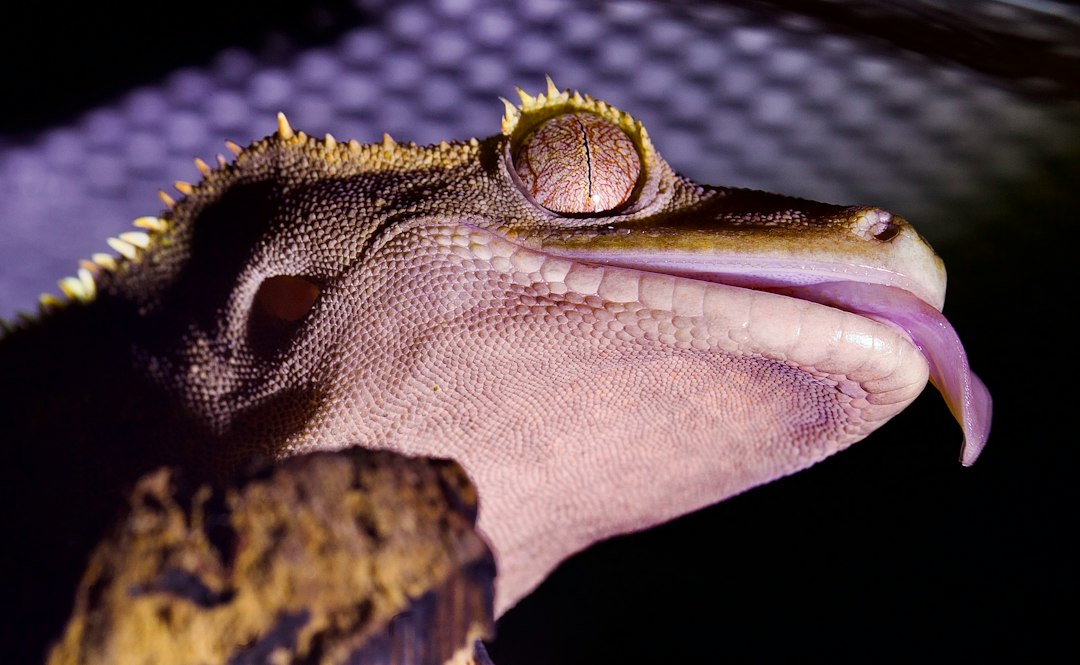
Photo by Andrey Tikhonovskiy on Unsplash
What Causes Respiratory Infections in Crested Geckos
Crested gecko respiratory infections are almost always husbandry-related rather than spontaneous. The primary drivers are:
Sustained temperatures above the comfort ceiling. Crested geckos are native to New Caledonia, where ambient temperatures rarely exceed 80°F (27°C) in the warmest months. Sustained exposure above 82-85°F suppresses immune function and creates conditions where opportunistic bacteria (Pasteurella, Pseudomonas, and Aeromonas species are commonly implicated) can overwhelm a gecko’s natural defenses. The Association of Reptilian and Amphibian Veterinarians consistently identifies chronic thermal stress as a primary precursor to bacterial respiratory disease in arboreal lizards.
Humidity extremes on both ends. Critically low humidity dries out the delicate mucous membranes lining the respiratory tract, reducing the gecko’s ability to trap and clear airborne pathogens. Permanently saturated conditions with no dry period promote bacterial and fungal growth throughout the substrate and on the animal itself. The target is not constant high humidity but a wet-to-dry cycle: mist heavily in the evening, allow the enclosure to drop to 50-60% relative humidity by midday, then repeat. This cycle mirrors natural New Caledonian daily humidity variation.
Poor ventilation and stagnant air. An enclosure with inadequate air exchange allows CO2 to accumulate and creates microenvironments of sustained high humidity near the substrate surface. Screen-topped enclosures can dry too quickly in low-humidity rooms; front-opening glass terrariums with minimal ventilation panels can develop dead air pockets in lower corners. Neither design is inherently problematic, but each requires deliberate placement and monitoring to achieve adequate airflow throughout the enclosure volume.
Viral suppression enabling secondary infections. Nidovirus has been documented in both wild-caught and captive crested geckos and can suppress immune response, making secondary bacterial respiratory infections more severe and harder to resolve. Animals acquired from mass-market pet stores or unknown-provenance breeders carry higher exposure risk. A standard 60 to 90 day quarantine period in a separate room with separate equipment is the correct response when introducing any new gecko to an established collection.
Cross-contamination in multi-species setups. Respiratory pathogens do not always respect species boundaries in a shared airspace. Housing crested geckos in close proximity to snakes or lizards with active infections raises exposure risk, particularly in reptile rooms with limited air circulation between enclosure areas.
Crested Gecko Eye Health: What Can Go Wrong
Eye problems in crested geckos fall into three main categories, each requiring a distinct response.
Retained eye cap during shed. Unlike most lizards, crested geckos cannot close or blink their eyes. A fixed transparent scale called the spectacle (also called the brille) covers each eye and sheds along with the rest of the skin. When a shed goes wrong, whether from low ambient humidity, dehydration, or inadequate misting frequency, the old spectacle can adhere to the new one forming beneath it. A single retained shed is manageable with prompt, careful intervention. Two or three successive retained specs create cumulative pressure on the underlying eye tissue and can result in permanent vision damage if left unaddressed.
Bacterial conjunctivitis. Substrate debris pressed against the eye, damp bedding in contact with the periorbital area, or opportunistic bacteria thriving in an over-humid enclosure can all trigger infection presenting as swelling, discharge, or a cloudy appearance behind the spectacle. Veterinary antibiotic eye drops are the correct treatment. Home application of over-the-counter products formulated for mammalian eyes should not be attempted without veterinary guidance, as pH and concentration differences between species risk additional tissue damage.
Physical injury and foreign body irritation. Live feeder insects, particularly crickets with their spurs and mandibles, can injure a crested gecko’s eye during an active feeding session. Loose substrate particles or fine plant material can lodge at the spectacle margin and cause persistent mechanical irritation. Feeding in a separate container and removing uneaten feeders promptly eliminates most of this risk.
Periorbital abscess formation. Untreated conjunctivitis or repeatedly retained shed complications can progress to abscess formation around the eye socket. This is a late-stage outcome requiring surgical debridement by a qualified reptile veterinarian. It is avoidable in nearly every case through early intervention at the first sign of swelling or retained material.
Humidity as Your Primary Defense Against Crested Gecko Respiratory Infections
Stable, cyclical humidity is the single most effective preventive measure against both crested gecko respiratory infections and eye problems. The target range is 60-80% relative humidity during and after misting, dropping to 50-60% between misting cycles. Temperature should remain between 68-78°F (20-25°C) consistently, with 72-75°F as the practical daily target for most keeper environments.
What matters as much as the target numbers is cycling consistency. A gecko that experiences a reliable wet-dry pattern every day is significantly more resilient than one kept at a nominally correct average humidity that includes daily spikes to 88% from poor ventilation followed by crashes to 35% when the central air runs. Stability reduces immune suppression; reliable cycling keeps respiratory membranes hydrated and discourages fungal overgrowth in substrate.
Accurate, continuous measurement is non-negotiable. Analog dial hygrometers are notoriously inaccurate and should not be trusted for crested gecko health decisions. The Govee Indoor Hygrometer Thermometer H5075 with Bluetooth App Control tracks humidity and temperature with readings accessible from a smartphone app. The app connectivity is the critical feature: you can review how humidity has trended over time, identify the afternoon low you would have missed by only checking at misting time, and catch gradual drift caused by seasonal changes in home HVAC behavior before those changes compromise your gecko’s respiratory health.
A detailed breakdown of crested gecko humidity targets, seasonal variation drivers, and equipment placement strategies is available in the Crested Gecko Humidity and Temperature Management Guide.
Setting Up a Reliable Misting and Monitoring System
Manual misting with a spray bottle is adequate for attentive keepers with one or two enclosures and consistent daily schedules. For larger collections or keepers whose availability varies, an automated misting system is the most reliable way to maintain the wet-dry cycle that prevents respiratory and eye problems. The following comparison covers the three tools that form a complete humidity monitoring and delivery setup, followed by a step-by-step installation sequence.
Equipment comparison for crested gecko humidity management:
| Tool | Primary Function | Best Application | Key Limitation |
|---|---|---|---|
| Govee Indoor Hygrometer Thermometer H5075 with Bluetooth App Control | Humidity and temperature monitoring with app access | Real-time monitoring with trend review via app | Monitoring only; does not deliver or control humidity |
| Exo Terra Monsoon Solo II | Automated misting | Programmable wet-dry cycle delivery | Reservoir requires regular cleaning to prevent bacterial film buildup |
| Zoo Med Repti Fogger | Mist generation | Supplemental ambient humidity support between primary misting sessions | Produces aerosol, not surface wetting; continuous use promotes bacterial growth in substrate |
The three tools complement rather than duplicate each other. The hygrometer tells you what humidity is doing over time, the Monsoon Solo II delivers the primary misting events that create the wet-dry cycle, and the Repti Fogger supports ambient overnight humidity when indoor air tends to dry out most. Do not use the fogger as a primary misting replacement.
Step-by-step setup for a single crested gecko enclosure:
-
Calibrate the hygrometer before positioning it. Place the Govee H5075 next to a reference device you trust for 24 hours before committing to an enclosure location. If the readings diverge by more than 5%, replace the unit before relying on it for health monitoring decisions.
-
Position the probe at mid-enclosure height. Humidity stratifies vertically in a tall arboreal enclosure, reading higher near the substrate and lower near ventilation panels. Placement at the height of your gecko’s primary resting zone gives the most actionable data.
-
Install the Exo Terra Monsoon Solo II and program an initial two-session schedule. Set a longer evening misting event and a shorter morning session. Review humidity data over the next 48 hours to see how quickly the enclosure returns to the 50–60% midday baseline, then adjust session duration based on actual drop rate rather than guessing.
-
Direct misting nozzles toward back walls and plant canopy, not toward hides. Saturating a hide during a misting event creates thermal stress for a resting gecko. Back-wall and plant canopy coverage wets surfaces adequately while leaving the hide as a predictable dry refuge.
-
Add the Zoo Med Repti Fogger as supplemental overnight support if room humidity drops below 40% during the heating season. Program it on a timer during pre-dawn hours when indoor ambient humidity typically bottoms out. Never run the fogger continuously; prolonged aerosol delivery without a dry period promotes bacterial proliferation in substrate and on the gecko’s skin folds.
-
Review logged data weekly throughout your first heating season. Central heating reduces indoor relative humidity significantly, and a misting schedule calibrated in September will often under-deliver in December. Increasing session duration by 20-30% when the heat turns on is a practical starting adjustment; refine from there using logged data.
The full comparison of automated misting systems for multi-enclosure setups, including nozzle configurations and reservoir sizing, is in the Best Automatic Misting Systems for Crested Gecko Humidity Control guide.
Recognizing Warning Signs That Require Veterinary Attention
Early intervention is the difference between a short antibiotic course and a prolonged, expensive treatment outcome. The following symptoms warrant contact with a reptile-experienced veterinarian within 24-48 hours. Continued observation is not the appropriate response to any of these signs.
Respiratory warning signs:
- Audible wheezing, clicking, or gurgling during normal breathing
- Open-mouth breathing at rest (brief open-mouth breathing during active handling may not be significant; persistent open-mouth breathing while at rest is)
- Nasal discharge of any consistency, whether clear, cloudy, or mucoid
- Head tilting or persistent lean to one side, which may indicate infection has reached the inner ear
- Lethargy combined with appetite loss lasting more than five to seven days without an obvious non-illness explanation such as a pending shed
Eye warning signs:
- Swelling around or behind the spectacle
- Persistent cloudy or opaque appearance that does not resolve after a complete shed
- Retained shed visible on the spectacle more than 48 hours after the rest of the body has shed normally
- Any visible discharge from the periorbital region
- Asymmetry between the two eyes, particularly one appearing smaller or sunken relative to the other
The Merck Veterinary Manual’s guidance on reptile respiratory disease notes that bacterial infections in reptiles can progress from mild mucosal inflammation to systemic pneumonia within days when thermal stress is ongoing. A 48-hour window to contact a vet is already generous; if visible symptoms are present, same-day contact is appropriate.
If you have not yet identified a reptile veterinarian in your area, the Reptile Veterinary Care: Finding a Herp Vet on a Budget guide covers locating ARAV-listed practitioners and what to expect from a reptile wellness examination.
Common Mistakes That Lead to Crested Gecko Respiratory Infections and Eye Problems
Most preventable respiratory and eye cases trace back to a short list of avoidable errors. These are the patterns that appear most consistently in veterinary case discussions and keeper community troubleshooting threads.
Relying on a single point-in-time humidity reading. A keeper checks the hygrometer at 8 PM, sees 72%, and considers the husbandry adequate. But that reading says nothing about what happened at 2 PM when the air conditioning ran for two hours and the enclosure dropped to 38%. Data logging solves this immediately. A hygrometer that only displays the current reading cannot support reliable health monitoring, regardless of its advertised accuracy.
Using a fogger as a complete substitute for direct misting. Foggers produce fine aerosol particles that raise ambient relative humidity readings without actually wetting surfaces or substrate. A gecko living in a perpetually fogged enclosure may register 65% humidity while the spectacle scales dry out between sheds because no direct surface moisture is being deposited. Foggers serve a legitimate supplemental role for overnight ambient support; they are not a replacement for timed direct misting events from a system like the Monsoon Solo II.
Skipping consistent weight tracking. A crested gecko fighting a sub-clinical respiratory infection will often show gradual weight loss before any visible physical symptoms appear. Consistent weekly weighing on a gram scale catches this early. The Crested Gecko Body Condition Score guide provides a visual reference for what healthy versus declining condition looks like across weight stages.
Positioning enclosures in dead-air zones. Front-opening glass terrariums with minimal ventilation panels can develop stagnant air pockets in lower corners where humidity stays permanently elevated and airborne pathogens concentrate. A low-speed fan pointed at the room, never directly at the enclosure, improves air turnover noticeably without crashing humidity below target. Placement near HVAC vents or drafty windows creates the opposite problem.
Applying mammal-formulated products to gecko eyes. A rinse with sterile saline solution is generally safe for flushing visible debris from the area around the spectacle. Any medicated ophthalmic product formulated for dogs, cats, or humans should not be applied to a crested gecko’s eye without direct veterinary guidance. The pH and concentration differences between mammalian and reptile ophthalmic physiology make inappropriate products a credible source of additional corneal or spectacle damage.
Introducing new animals without quarantine. A gecko that appears healthy at purchase may carry Nidovirus, subclinical bacterial respiratory infection, or transmissible parasites. The standard protocol is 60 days of isolation in a completely separate room with separate tools and hand hygiene between animals. Bypassing this step is one of the fastest ways to spread a respiratory pathogen through an otherwise healthy collection.
Running misting equipment without regular maintenance. The Exo Terra Monsoon Solo II reservoir and nozzle lines can develop bacterial biofilm with regular use. Periodic reservoir flushing and nozzle rinsing prevents contaminated mist from being delivered into the gecko’s respiratory environment with every scheduled misting event.
Frequently Asked Questions
How do I tell the difference between a respiratory infection and normal settling-in stress?
Stress in a newly acquired crested gecko typically presents as hiding, color change, and reduced appetite during the first two to four weeks. It improves steadily as the gecko habituates to its environment. Respiratory infection symptoms follow a different pattern: they persist or worsen regardless of how much time has passed, and they produce physical signs that stress does not. Audible breathing sounds, nasal discharge, and open-mouth breathing at rest are not stress responses. A gecko that was eating normally and behaving predictably and then develops any of these signs warrants veterinary evaluation promptly, not additional time waiting for acclimation to run its course.
Can I treat a retained eye cap at home?
For recent, soft retained shed on the spectacle from the most recent shed cycle, a 15 to 20 minute humid chamber soak in a small deli cup with damp paper towels sometimes allows the retained material to loosen enough for very gentle removal with a moistened cotton swab tip. This is only appropriate when the retained shed is fresh, the eye shows no swelling or discharge, and you can handle the gecko calmly without added stress. Any retained shed that has persisted through more than one shed cycle, any visible periorbital swelling, and any cloudiness behind the spectacle are all beyond appropriate home treatment. Attempting to strip adherent retained spectacle without proper technique risks tearing the underlying brille tissue and causing permanent damage.
What humidity range prevents crested gecko respiratory infections?
The target is a cyclical range, not a fixed number. During and immediately after a misting event, aim for 70-80% relative humidity. Allow the enclosure to drop back to 50-60% before the next misting cycle begins. This wet-dry pattern mirrors natural New Caledonian daily humidity variation and prevents both the dry-membrane conditions that impair pathogen clearance in the respiratory tract and the perpetually saturated conditions that encourage bacterial and fungal growth throughout the substrate. A gecko whose enclosure stays above 85% with no dry phase faces meaningful respiratory health risk, not merely a humidity reading that skews slightly high.
How often should misting equipment be cleaned to protect respiratory health?
The Exo Terra Monsoon Solo II reservoir and nozzle lines benefit from a complete flush on a regular schedule under normal use. Stagnant water in a warm reservoir can develop bacterial biofilm within days, and that contamination gets delivered directly into the enclosure with every scheduled misting event. The Zoo Med Repti Fogger water chamber should be emptied and dried between daily uses rather than left with standing water between sessions. For the enclosure itself, remove uneaten CGD within 24–48 hours and wipe interior glass and decor surfaces weekly to reduce pathogen-supporting buildup.
Prevention Is the Entire Strategy
Crested gecko respiratory infections and eye problems are not random health events. They are the downstream consequence of specific, correctable failures in humidity cycling, temperature stability, equipment maintenance, and enclosure hygiene. Every gecko that avoids a respiratory emergency is almost always one whose keeper measured humidity consistently over time, maintained a reliable wet-dry misting cycle, and caught gradual weight loss before it escalated into a diagnostic challenge.
The practical starting point is measurement. Install a logging hygrometer, review the weekly humidity trends, and adjust your misting schedule before seasonal HVAC changes do it for you. Identify a reptile vet in your area now, before you need one urgently. That combination of consistent monitoring and advance preparation, more than any single equipment choice, is what keeps preventable conditions from becoming expensive ones.
If this guide helped you build a more reliable setup, bookmark it for reference when your heating season starts and indoor humidity conditions shift.
Related Reading:
- Crested Gecko Humidity and Temperature Management Guide
- Best Automatic Misting Systems for Crested Gecko Humidity Control