Best UVB lighting for crested geckos nocturnal needs and top fixtures
This post contains affiliate links. As an Amazon Associate, I earn from qualifying purchases at no extra cost to you.
Crested geckos convinced a lot of keepers that lighting does not matter. They are nocturnal to crepuscular, they spend the day wedged into foliage, and they do well on complete powdered diets that already contain vitamin D3. So why does UVB keep coming up in every husbandry forum? Low-level UVB is increasingly treated as a safety margin for geckos, and the wrong fixture can injure an animal that cannot escape a bright, hot spot in a small enclosure.
The position here is simple. For most keepers, a low-output, shade-dweller class UVB source over a well-planted enclosure is a sensible upgrade. It is optional, and it only works when distance, cover, and a timer are right. Of the three fixtures supplied for this guide, one is a reasonable fit, one is workable with care and verification, and one should stay on the shelf. Below you will find how nocturnal habits change the math, how the fixture types differ, a step-by-step install, and the mistakes behind most UVB problems.
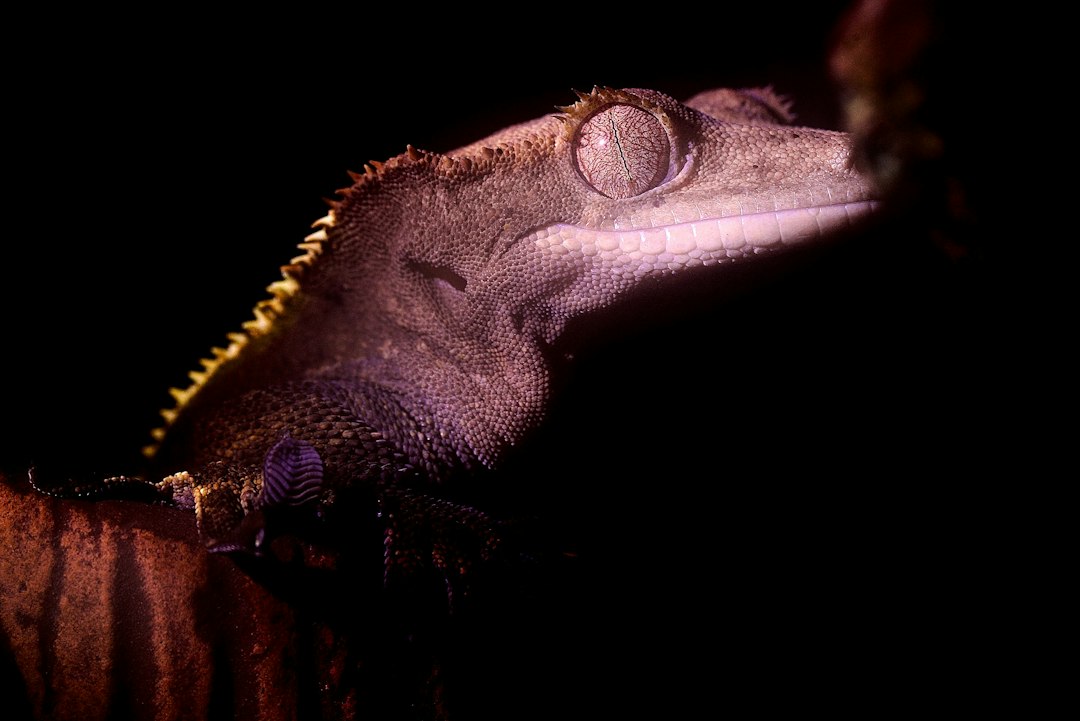
Photo by Andrey Tikhonovskiy on Unsplash
Why UVB Lighting for Crested Geckos Is Optional but Useful
Crested geckos (Correlophus ciliatus) come from the forests of southern New Caledonia. They climb through canopy and understory and shelter in leaf litter and bark crevices by day, and they are most active after dusk. That lifestyle exposes them to far less direct sun than a bearded dragon gets, which is why the traditional advice was to skip UVB entirely.
The biology that matters is this. In many reptiles, UVB exposure lets the skin produce vitamin D3, and D3 allows the gut to absorb calcium. Without enough D3, calcium goes unused and the animal can develop metabolic bone disease. The Merck Veterinary Manual’s reptile nutrition section covers this relationship and notes that vitamin D and UV requirements differ by species. For crested geckos, the established route is dietary D3, delivered through a complete crested gecko diet and, for some keepers, an occasional D3-containing supplement.
So why add UVB at all? There are two practical reasons. First, a UV gradient gives the gecko control. When light and shade both exist, the animal chooses its own exposure instead of depending entirely on your supplement schedule. Second, it is a hedge for keepers whose feeding routine is inconsistent, for example geckos that eat mostly insects or that refuse prepared diets for weeks.
The counterargument is just as real. No controlled study establishes a UVB requirement for this species, so treat it as an informed optional upgrade, not a medical necessity. If you keep one healthy gecko on a quality diet in a planted enclosure, you are not neglecting it by skipping UVB. The upgrade makes the most sense when you already run a bioactive or heavily planted setup, want a belt-and-suspenders approach to calcium metabolism, and are willing to measure output instead of guessing.
The rest of this guide assumes you have decided to add it, and want to do it without creating a new problem.
How Nocturnal Habits Change UVB Lighting for Crested Geckos
A nocturnal animal needs a different lighting plan than a basking one. Ferguson zones, a classification herpetologists use to group reptiles by natural sun exposure, place crepuscular and shade-dwelling species in the lowest tiers, roughly Zone 1 to 2. That tells you what your fixture should do: provide a faint, widely spread glow that the gecko can sit in or avoid, not a bright patch it must tolerate.
Target low output, not a basking spot
Keeper guidance for shade dwellers commonly aims for a UV Index of roughly 0.5 to 1.0 at the brightest perch, falling toward zero in shaded areas. That range is a widely cited convention, not a research-established dose for this species, so treat it as a starting point and watch your animal. The practical takeaway is that a bulb sold for desert basking species is the wrong tool, and even “forest” class bulbs need distance.
Build a gradient, not a floodlight
Crested geckos spend daylight hours tucked into cover. If every perch in the enclosure sits under strong UV, the animal has no refuge and will either stress or hide permanently. Aim for UV over no more than about a third to half of the enclosure, with dense foliage, cork flats, and a shaded hide area beneath or beside it. Place the brightest zone on the upper portion of one side, where a gecko might naturally hang during early evening activity.
Match the photoperiod to the room
UVB should run during daylight hours only, usually 10 to 12 hours, on a timer. Crested geckos also need a real night. They do best with cooler nighttime temperatures and darkness, and constant light disrupts their rhythm. Keep temperatures in the low to mid 70s Fahrenheit and avoid exceeding the low 80s, which means a fixture that adds heat is a liability. Review the crested gecko humidity and temperature management guide before choosing a fixture, because a lamp that raises enclosure temperature can undo your humidity and cooling plan.
Account for mesh and glass
Glass blocks essentially all UVB, so a fixture shining through a glass lid does nothing. Fine mesh tops absorb a meaningful share, with figures of 30 to 50 percent commonly cited depending on the weave. This is why mounting position and distance matter more than the number printed on the box.
Linear Tubes vs Compact Bulbs vs Mercury Vapor
Fixture type affects UV spread, heat, and risk more than brand does. For a deeper look at matching output tiers to species, see the guide on how to choose the right UVB bulb for any reptile. Here is how the main categories stack up for crested geckos specifically.
| Fixture type | UV spread | Heat output | Fit for crested geckos | Main drawback |
|---|---|---|---|---|
| Linear T5 HO, shade-dweller tier (about 5 to 7%) | Wide, even | Low to moderate | Best choice | Needs a reflector and enough mounting space |
| Linear T8, low output | Wide, weaker | Low | Good for short enclosures | Output drops quickly with mesh and distance |
| Compact fluorescent (CFL) | Narrow, concentrated | Low to moderate | Acceptable with caution | Uneven coverage; reports of eye irritation at close range |
| Mercury vapor | Wide, intense | High | Poor | Heat and UV far too strong for a small humid vertical setup |
Linear tubes win for one reason: they spread low-level UV across the length of the enclosure, so the gecko meets a gradual change instead of a hot cone. If you can fit a tube above or beside the mesh, that is the setup most keepers and veterinarians favor for shade dwellers.
Compact bulbs are popular because they screw into a standard dome fixture and cost little. The tradeoff is geometry. The output is concentrated beneath the bulb and drops off sharply to the sides, so a small tall enclosure ends up with an intense spot and little else. Some manufacturers and keeper communities have also reported eye and skin irritation with compact UVB bulbs, especially when animals can get close. That does not make them unusable, but it does mean distance, shade, and screening matter.
Mercury vapor bulbs combine heat, UVA, and UVB in one self-ballasted lamp. They are excellent for large enclosures holding basking species and a poor match for a 18-by-18-by-24 inch gecko terrarium.
Best UVB Lighting for Crested Geckos: The Three Fixtures Compared
The three products below are the ones supplied for this guide. Specifications change between product revisions, so confirm the UVB percentage, dimensions, and fixture requirements on the current listing before you buy.
Zoo Med ReptiSun 5.0 Mini Compact Fluorescent Lamp, 13 Watts
The Zoo Med ReptiSun 5.0 Mini Compact Fluorescent Lamp 13 Watts is the most reasonable pick of the three for most crested gecko setups. At 13 watts it is the lowest-wattage option here, which suits a shade-dwelling species. Check the product listing for fixture compatibility before buying.
The limitation is the compact format. Mount it high, on the outside of a mesh top, and keep the gecko’s highest perch well below it. Angle the dome so the bulb covers one side of the enclosure instead of the center. If you have a tall enclosure with a lot of climbing structure, this bulb is a workable budget option. If you can fit a linear tube instead, the tube remains the better tool.
D3 UVB Compact Bulb, 23 Watts, Forest
The D3 UVB Compact Bulb - 23W - Forest is the one to verify before you commit. The “Forest” label suggests a tier intended for shade-dwelling species, which is the right category. The 23-watt rating is notably higher than the ReptiSun mini, so confirm the output and heat for your mounting position before using it.
Check the listing for the manufacturer’s UV Index chart at specific distances. If the chart shows readings well above 1.0 at the distances available in your enclosure, either raise the fixture, add a layer of shade, or choose a lower-output option. With a 23W compact, a short enclosure is a poor fit, while a tall 24-inch or 36-inch setup with a high mount gives you room to work.
Exo Terra Solar-Glo 125-Watt Mercury Vapor Lamp
The 125-watt Exo Terra Solar-Glo High Intensity Self-Ballasted Uv/Heat Mercury Vapor Lamp, vapor bulbs is a legitimate product for the right animal. It is a mistake for crested geckos. A 125-watt UV/heat lamp can push a gecko terrarium past the low 80s Fahrenheit, which is the range where crested geckos begin to suffer.
Crested geckos have no need for a basking spot, and a high-intensity UV cone leaves a nocturnal animal with nowhere comfortable to hide. If you keep other species such as bearded dragons, this lamp may suit them better. For a crested gecko, skip it.
How to Install UVB Lighting for Crested Geckos Step by Step
Safety warning: UVB fixtures are electrical equipment used in a humid, frequently misted environment. Plug everything into a GFCI-protected outlet, route cords with a drip loop so water cannot run down them into the socket, and keep fixtures out of direct mist paths. Use a ceramic-socket fixture rated above the bulb’s wattage. UVB can injure eyes and skin at close range, and fluorescent bulbs contain mercury, so ventilate the room if one breaks and do not throw used bulbs in household trash. If your gecko shows squinting, eye discharge, or sudden avoidance behavior, turn off the lamp and contact an exotic veterinarian. The Association of Reptile and Amphibian Veterinarians maintains a directory of vets who see reptiles.
- Measure the enclosure height and the distance from the mesh top to the highest perch. This number decides whether a compact bulb or a linear tube will work.
- Choose a low-output fixture. A shade-dweller tier linear tube is the first choice; a 13W compact in a tall enclosure is the budget alternative.
- Mount the fixture on one side only. Position it above the mesh so the UV covers no more than a third to half of the enclosure, leaving the rest in shade.
- Add cover under and around the lit zone. Use cork flats, foliage, and a hide so the gecko can retreat out of the beam at any time.
- Plug the fixture into a timer. Set it to run 10 to 12 hours during the daytime, and turn it off completely at night.
- Measure the output. A handheld UV Index meter, used at the brightest perch and at a shaded one, tells you what the gecko actually receives. Adjust height until the brightest perch is in the low range and the shaded zones read close to zero.
- Observe for two weeks. Watch for avoidance, squinting, or sudden hiding, and adjust distance or shade if you see them.
- Write the install date on the fixture or in a log. UV output declines before visible light fades, so you need the date to schedule replacement.
Common UVB Mistakes to Avoid
Most UVB problems are setup problems, not product problems. These are the ones that show up repeatedly in keeper communities and veterinary guidance.
- Skipping the meter. The percentage on a box is not what your gecko receives. Mesh, distance, and bulb age all change the real number, and a handheld UV Index meter is the only way to know.
- Mounting too close. A bulb a few inches above a perch can deliver many times the intended output. Distance is your main safety tool, and compact bulbs punish short distances most.
- Lighting the whole enclosure. If every surface sits under UV, the gecko has no refuge. Always keep a large shaded zone.
- Running lights around the clock. Constant light erases the night that a nocturnal species needs. Use a timer, every time.
- Ignoring heat. A fixture that raises enclosure temperature into the 80s defeats the purpose. Watch your thermometer for the first few days after installing any lamp, and compare it to your normal range.
- Using glass or tight barriers. UVB through glass is blocked, and a thick plastic or acrylic lid can do the same. Confirm the light path is mesh or open.
- Forgetting replacement dates. Fluorescent tubes are often rated for around a year and compact bulbs for around six months, though manufacturers vary. A bulb that still looks bright may no longer produce meaningful UVB.
- Stacking supplements without thinking. If you add UVB, keep your D3 supplementation moderate and follow the dosing guidance on your products and your vet’s advice, rather than assuming more is safer.
If something looks wrong, turn the lamp off first, then troubleshoot. A gecko that hides constantly, closes one eye, or avoids its usual perches after a lighting change is telling you the output is too high or the shade is too thin.
Frequently Asked Questions
Do crested geckos need UVB?
No controlled study establishes a UVB requirement for crested geckos, and many animals live long, healthy lives on complete diets with dietary vitamin D3 and no UV lighting. UVB is best treated as an optional upgrade that gives the gecko choice and acts as a safety margin for calcium metabolism. It makes the most sense in planted or bioactive enclosures where you can create shade and a gradient. If you add it, use a low-output fixture, verify output with a UV Index meter, and stay in contact with an exotic veterinarian if you have any health concerns.
How many hours a day should UVB run for a crested gecko?
Run UVB for roughly 10 to 12 hours per day, on a timer, during the same hours the room is lit. Turn it off completely at night so the gecko gets true darkness and a cooler temperature drop. Constant lighting disrupts the activity pattern of a nocturnal species and can raise enclosure temperatures. Some keepers shorten the photoperiod slightly in winter to mimic seasonal changes, which is fine as long as the cycle remains predictable. Whatever schedule you choose, keep it consistent, because irregular on and off cycles are more stressful than a slightly shorter day.
Can I use a UVB bulb as a heat source?
You should not need to. Crested geckos do well at room temperatures in the low to mid 70s Fahrenheit and become stressed when enclosure temperatures climb into the 80s. A UVB bulb that also functions as a heat source, such as a mercury vapor lamp, creates exactly the overheating risk you want to avoid. Choose a fixture that produces UV with minimal heat, place a thermometer at the highest perch, and confirm temperatures stay within range after the lamp has been on for several hours. If the room runs cold, use gentle room heating instead of a lamp.
How often should I replace a UVB bulb?
Follow the manufacturer’s guidance, which typically falls around 12 months for linear fluorescent tubes and around six months for compact fluorescent bulbs. UV output fades before visible brightness does, so a bulb that looks fine may no longer deliver useful UVB. A UV Index meter lets you replace based on measured output instead of calendar dates. Write the install date on the fixture or in a log, and dispose of used bulbs through a hazardous waste or household recycling program, since fluorescent bulbs contain a small amount of mercury.
Conclusion
For most crested gecko keepers, UVB is a worthwhile optional addition when it is low-output, mounted high, and paired with plenty of shade. A linear shade-dweller tube is the best choice, the 13W ReptiSun 5.0 mini is a reasonable budget alternative in a tall enclosure, the 23W compact needs verification and more clearance, and the 125W mercury vapor lamp does not belong over a gecko. Your next step is simple: measure your enclosure height and the distance from the mesh to the highest perch. That single number tells you which fixture fits, and a UV Index meter tells you whether your setup is actually safe.
Bookmark this guide or subscribe via RSS so you can find the install steps and replacement reminders when it is time to change your bulb.